
What is the Fair Credit Reporting Act (FCRA)?
FCRA is legislation that the U.S. Federal Government enacted to promote the accuracy, fairness, and privacy of consumer information embedded within the files of consumer reporting agencies (Equifax, Experian, TransUnion). In short, this Act allows consumers to have rights as it pertains to the information on their credit report. It states that you have the right to dispute any incomplete or inaccurate information and the consumer reporting agencies must correct or delete this inaccurate, incomplete, or unverifiable information within 30 days. However, if a consumer reporting agency has verified that the information is accurate, it may continue to report such information.
What is Credit?
Simply put, credit is the ability to obtain goods or services before having to make an actual payment. In turn, the party that extends the credit(creditor) will charge an interest rate. The interest rate depends on an individual’s or business’s credit worthiness.
How is credit worthiness determined?
Credit worthiness is determined by giving individuals and/or businesses a score. The score ranges from 300-850 depending on various factors. The higher the score, the more credit worthy you are, resulting in lower interest rates in addition to many other advantages.
How do I achieve a high score?
A high score is achieved by a variety of factors, some more heavily weighed than others. See chart below.
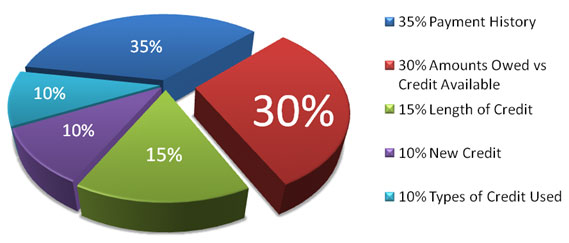
As you probably noticed, payment history makes up 35% of your credit score and credit utilization makes up another 30%. Just these two components alone make up for more than half of your credit score. And although the factors do not weigh as much, they still play an important role in achieving a high credit score.
What is credit restoration?
Credit restoration is the process of restoring your credit to a previous acceptable level after having it brought down by a variety of negative reasons. The process involves sending dispute letters to all 3 credit bureaus, as well as changing personal finance behavior. This includes making on-time payments to creditors, paying down balances, and refraining from soliciting new lines of credit.